

Mercedes-Benz HPC operates its DC fast charging network the way the brand operates everything: to spark a simple “Welcome home” feeling where thoughtful innovation makes life feel more effortless. Delivering a superior charging experience is the expectation, and brand promise.But the Mercedes-Benz HPC operations team recognized a problem endemic to public charging they could solve in a unique way.
When a driver arrives at a charger and something goes wrong — a payment that won’t process, an error code they can’t interpret, a plug that won’t release — they face three options: call support, figure it out on their own, or leave. Most don’t call. Many leave.
That last group is where revenue leaks. A driver who leaves the site without charging does not generate a ticket, alert, or backend event. They disappear from every metric that exists, and they are far less likely to return due to not successfully charging their EV. They leave with a poor experience and less confidence in the charging station brand.
The Mercedes-Benz HPC team mapped the dynamics driving that gap:
The goal: Reach those drivers at the charger, in the moment, before they leave without charging — without a long integration project, added headcount, or disruption to existing operations.
Mercedes-Benz HPC and ChargeMate designed the pilot around a single question: Can AI support reach a driver mid-failure, resolve the issue in real time, and turn a likely abandoned visit into a completed charge and delighted driver?
The initial deployment was deliberately lean. ChargeMate went live across six high-traffic DC fast charging sites in under three weeks. Drivers accessed support via QR codes posted at each charger. The existing phone support line ran without modification — ChargeMate operated as an additional channel alongside it, not a replacement.
Mercedes-Benz HPC required a support system trained on EV-specific failure modes—the actual error patterns, payment edge cases, connector behaviors, and hardware failure signatures that occur at DC fast chargers. A driver in front of an Alpitronic HYC 400 unit reporting a ground fault error needs a different answer than a driver with a stuck CCS plug. And a driver traveling alone has different needs than one traveling with a family.
Mercedes-Benz HPC defined five support scenarios based on what their drivers encountered most frequently:
Mercedes-Benz HPC ran ChargeMate alongside control sites over the same period. The results:

AI chat support cut call volume nearly in half and served nearly two times more drivers than the existing call center alone. Adding an easy self-serve channel increases the number of drivers who engage withCustomer Support and thus the number of opportunities to improve customer experience.
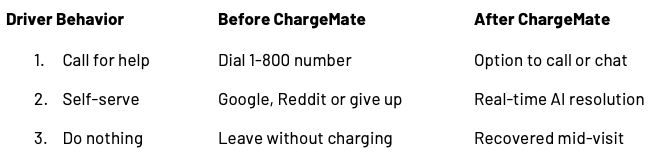
The call center doesn’t typically reach drivers #2 and #3 – those drivers leave before they call for help. A recovered visit that would have otherwise failed is incremental revenue that never appeared in any prior metric because it was never a support interaction. It was a silent failure.
The pilot also produced a valuable operational dataset: 40+ distinct driver-reported issues with enough specificity to drive immediate improvements. Mercedes-Benz HPC used that data to update HMI guidance and payment systems across pilot sites.
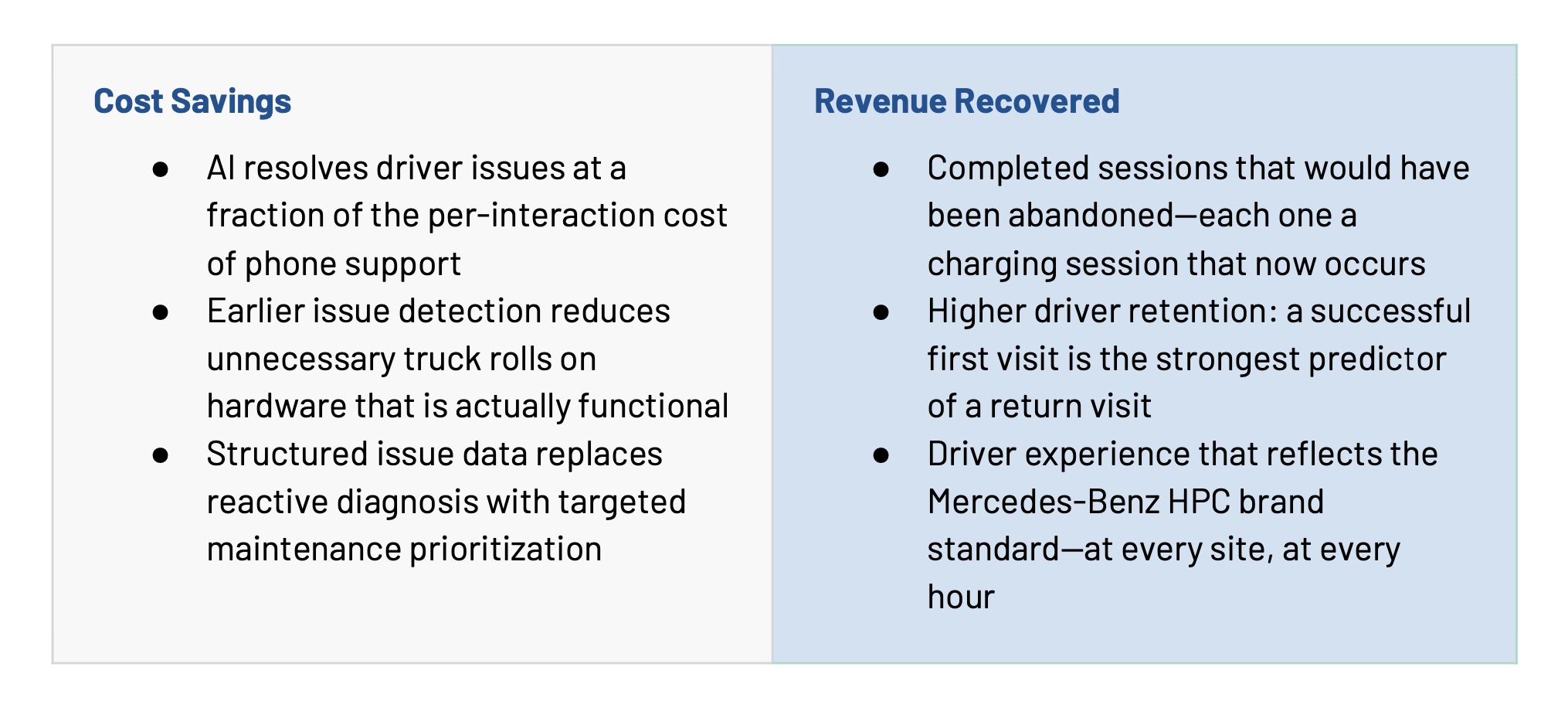
Most networks treat driver support as overhead to minimize. Mercedes-Benz HPC treated it asa margin recovery, intelligence signal, and delivering on the brand promise.
Every driver who arrives at a Mercedes-Benz HPC site and whose charging session fails silently — represents a lost session, a lost return visit, and a crack in the brand trust they work to build. Catching those drivers before they leave — and converting their visit into a completed charge — is real revenue that would otherwise never appear. It’s also an opportunity to rapidly identify fault patterns early and reduce the number of future potential driver charging issue.
As public charging grows more competitive, the networks that retain drivers will be those that earn trust at the charger — especially in the moments when things don’t go perfectly. A driver who fails silently once rarely gives the network a second chance. A driver who gets immediate help and completes their charge is a happy customer more likely not only to return — but leave positive reviews and word of mouth exposure.
"For Mercedes-Benz HPC, quality is foremost, and that’s why we chose ChargeMate. Their AI filled a gap that gave our team insights to improve the customer support experience, optimize internal workflows, and recover lost sessions — all improving success rates and driver retention.” - Madeline Ebert, Head of Product, Mercedes-Benz High-Power Charging

